Table of contents
Industrial estates, logistics parks, and manufacturing campuses are being forced to redraw their maps as electric fleets scale up, grid constraints tighten, and planners face new fire-safety, traffic, and power-quality questions. What used to be a “nice-to-have” amenity, a handful of chargers near the front gate, is becoming a hard piece of infrastructure with spatial consequences, from cable routes and substations to queuing lanes and driver welfare. The shift is already reshaping capex priorities, permitting timelines, and day-to-day operations across Europe and North America.
Power is now a land-use problem
“Where will the chargers go?” is no longer the real question, because the decisive variable is power, and power has a footprint. A single fast charger can draw as much electricity as a small supermarket at peak, and industrial sites that want dozens of bays quickly reach multi-megawatt demand, a level that can trigger new substations, upgraded transformers, and medium-voltage cabling across the plot. For planners, that translates into reserved corridors, setback constraints, and coordination with utilities whose connection queues can stretch months or even years in constrained regions. Even when a site has ample acreage, the practical placement is dictated by switchgear rooms, cable length limits to control losses, and the ability to isolate equipment safely during maintenance.
Load management changes the layout too. Many operators avoid the highest connection fees by smoothing peak demand, yet that requires energy storage, on-site generation, or both, and each adds additional siting choices, from battery containers needing ventilation clearances to PV canopies that affect drainage and firefighting access. The result is a new planning logic in which the electrical single-line diagram influences circulation, security fencing, and even stormwater design. Industrial real estate teams increasingly treat grid capacity like water rights: a scarce resource that can determine whether a parcel is viable for future tenants, and therefore whether it holds its value.
Traffic flow replaces “one charger in a corner”
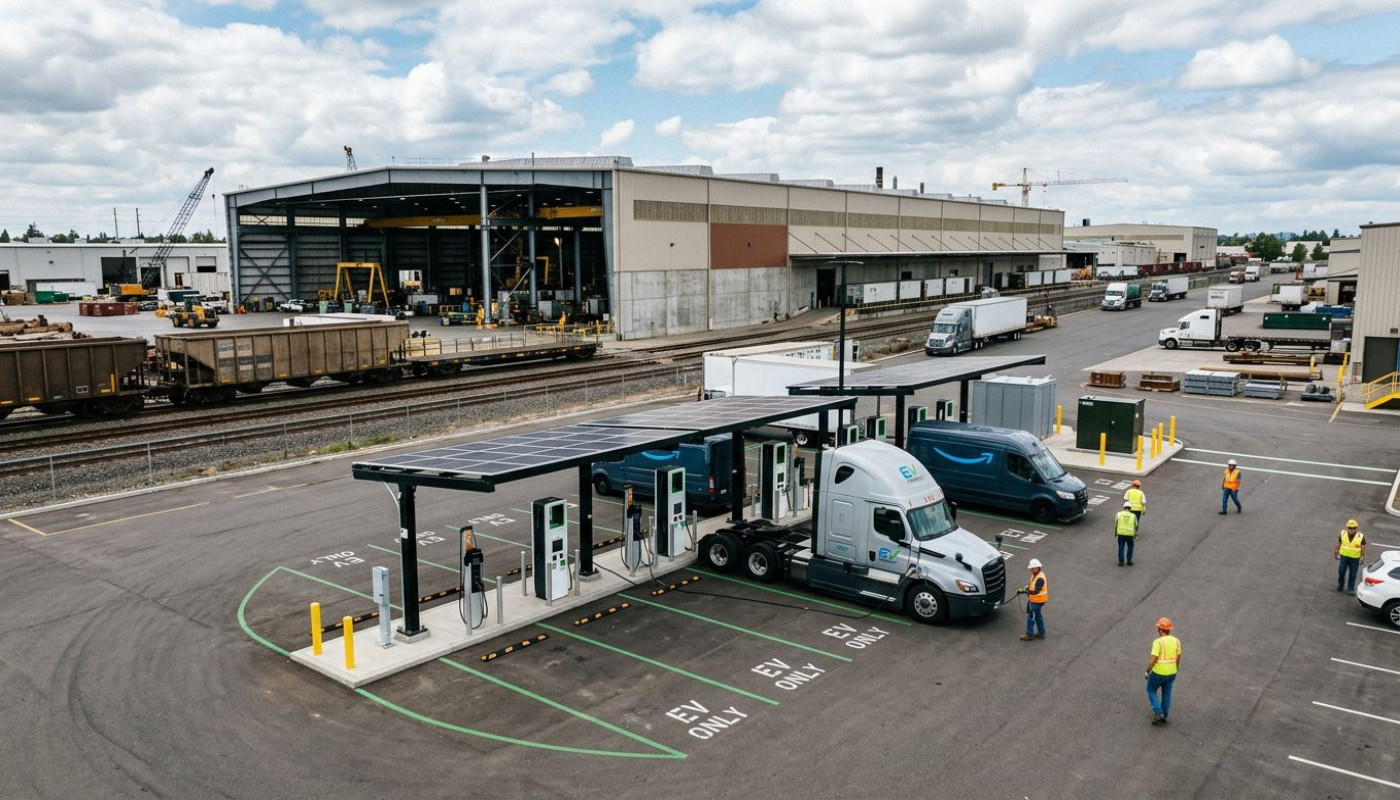
Charging is not parking, and the difference can upend an existing yard. When vehicles must cycle through bays on predictable schedules, the site needs stack-up space, turning radii, and clear rules for priority, otherwise queues spill into internal roads and compromise safety. This is especially acute for distribution centres adopting electric vans and trucks, where the fleet returns in waves, and dwell time is operationally critical. Planners are therefore borrowing tools from airport and port design, separating circulation loops, creating dedicated one-way lanes, and ensuring that a vehicle can enter, charge, and exit without complex manoeuvres that raise incident rates and slow throughput.
Human factors are also entering the drawing set. Drivers may need shelter, lighting, and safe pedestrian routes, particularly during night operations, and regulators are increasingly attentive to workplace risk assessments around high-power equipment. Poorly designed charging areas can create conflict points between forklifts, articulated trucks, and pedestrians, and because industrial sites often run tight margins, the hidden cost shows up quickly in delays and insurance claims. The best layouts treat charging as a process line, not a car park, with clear signage, physical segregation where needed, and a strategy for fault handling so one broken dispenser does not paralyse the lane.
Safety rules are rewriting the checklist
High-voltage infrastructure and high-energy batteries bring a different risk profile, and planners are being pushed to think beyond basic electrical compliance. Fire separation distances, emergency shut-off access, and ventilation requirements for enclosed or semi-enclosed areas can all influence where equipment is permitted, and local fire authorities may ask for explicit intervention plans. Even when national rules are still evolving, insurers often impose their own expectations, such as clear appliance access routes, protected cable trenches, and limits on combustible storage near charging zones. The net effect is that early engagement with safety stakeholders has become as important as the grid application itself, because redesigns late in the process can be expensive and slow.
Resilience is another safety-adjacent issue that changes planning. Many industrial tenants now require continuity: a cold-chain warehouse cannot simply “wait for power,” and a fleet depot cannot miss its dispatch window. That drives redundancy choices, such as multiple feeders, sectionalised switchboards, and the ability to isolate a fault without taking the entire yard offline. These features require space, and they need to be documented in an operational concept that planners can defend during audits. In practice, the most successful projects treat charging as critical infrastructure, with commissioning plans, maintenance access, and lifecycle replacement built into the design, rather than bolted on after the first season of use exposes weaknesses.
Modular hubs are changing how sites expand
The strategic challenge for many operators is uncertainty: fleet electrification is accelerating, yet the exact mix of vehicle types, charger powers, and duty cycles can shift within a few years. Planning for a fully built-out end state can overconsume land and capital, while underbuilding risks stranded operations and expensive retrofits. That tension is pushing interest toward modular architectures that can be deployed in stages, integrating power distribution, protection, metering, and control in a form that is easier to repeat across multiple sites. In that context, solutions such as the aventech skids hub are being discussed as a way to standardise how a charging yard is supplied and expanded, because a repeatable “electrical core” can shorten design cycles, reduce on-site complexity, and make later capacity additions less disruptive to operations.
For industrial site planning, the operational benefit is not only speed but also consistency. A modular hub approach can support clearer demarcation between utility interface, site distribution, and charger rows, and that separation helps project teams manage permitting, testing, and handover. It also makes multi-tenant estates easier to configure, as landlords can allocate capacity, measure consumption, and add bays without reopening the entire electrical design each time a new tenant arrives. The planning implication is straightforward: instead of reserving a large, speculative “future charging area,” sites can design a scalable backbone with defined connection points, leaving more flexibility for warehousing, parking, or production space while still protecting future electrification needs.
What planners should budget for next
Site owners should start with a phased masterplan, then secure a grid offer early, and budget not only for chargers but also for civils, switchgear, and utility works, which can rival the charging hardware in cost. Build a commissioning and maintenance plan into procurement, and reserve land for expansion corridors. For public support, check local and national subsidy windows before ordering equipment.
Similar
